The calendar changed. The work didn’t.
A changed week needs more than a tidier calendar. The hours displaced by appointments, delays and interruptions still belong to the project, even when they no longer have a place in the week.
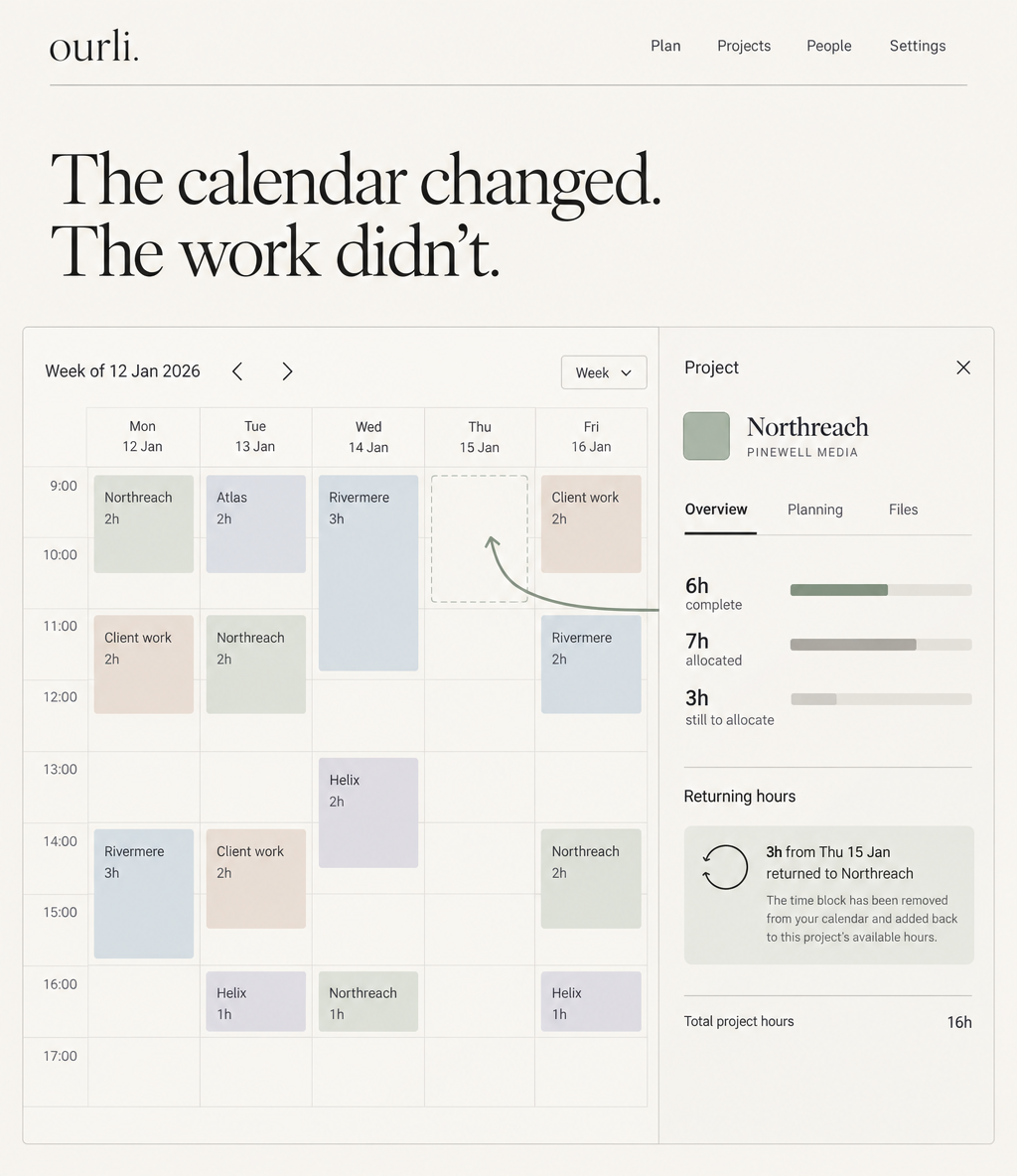
Most changes to a working week are reasonable. A client needs a call. An appointment runs long. A decision arrives too late for the work that depended on it. You adjust the calendar because the original arrangement no longer fits.
The calendar then looks accurate again. Tuesday reflects the appointment. Friday includes the call. The blocks that could not happen are gone.
But there are two records involved: the record of where your time will go, and the record of what you still owe. Editing the first does not necessarily update the second. Unless the displaced hours return to an unallocated project balance, a sensible calendar change can leave behind an unrealistic delivery plan.
What the edit needs to carry
Consider a designer with a twelve-hour piece of client work. Four hours are already complete. The remaining eight are allocated across the week: three on Tuesday, three on Thursday and two on Friday.
Then Tuesday’s availability disappears because of an appointment. The designer removes the three-hour block. Later, a client call takes one of Friday’s two hours.
Neither edit changes the brief. The project still needs the same work. Yet its place in the week has shrunk from eight hours to four.
At this point, the useful record is not simply “eight hours remaining”. It is “eight hours remaining, four allocated, four without a place”. That distinction makes the consequence of the changed week visible before the deadline is affected.
By Friday evening, suppose the designer has completed Thursday’s three hours and Friday’s one. The project now has four hours left, all unallocated. Those are the hours displaced earlier in the week. They have not become a new task or an estimating error. They are an existing commitment that lost its available time.
This is a small piece of bookkeeping, but it changes the next decision. A clear Monday morning is not necessarily spare capacity. It may be the first available place for work already promised.
Return the hours before moving them
The natural response to a lost block is to drag it somewhere else. Sometimes that is enough. There is a genuine opening, the work can happen there, and nothing else needs to move.
Often, though, immediate rescheduling hides the trade-off. Tuesday’s three hours move to Wednesday, displacing another project. That project moves to Friday, where it competes with administration. The calendar stays full and orderly while several commitments quietly become less secure.
A better sequence is to release the hours from their old allocation, then decide where they can realistically go. For a moment, let them be unallocated. This is not an omission in the plan. It is an accurate account of a problem that needs a decision.
The accounting matters here. If the project already shows eight hours remaining, removing a three-hour block should not increase that remainder to eleven. Those three hours were always unfinished. What changes is their status: they move from allocated time back into the balance still needing a place.
A block removed because the work was completed early is different. So is a block removed because the client reduced the scope. Each change needs its own treatment:
- Completed work reduces the amount remaining.
- Reduced scope changes the estimate of work still required.
- Lost availability returns unfinished hours to the unallocated balance.
Treating all three as a deletion loses information. Treating them differently keeps the plan connected to what actually happened.
This is one practical distinction between time blocking and forward planning. A block gives work a place. The wider plan needs to account for what happens when that place is no longer available.
Make the consequence explicit
Once displaced work is visible, the choices become more concrete. The designer can allocate four hours next week, move another commitment with agreement, reduce the scope with the client, or revise the delivery date. None is automatically the right answer. Each makes the cost of the changed week explicit.
The check does not need to become a long weekly ritual. After a meaningful calendar change, look at the affected project: how much work remains, how much still has time allocated, and how much is now waiting for a place. Do this before treating newly visible gaps as capacity for another promise.
It also gives a client conversation a factual basis. “I lost four hours of production time this week and need to move delivery to Tuesday” explains the consequence more clearly than a general account of being busy. It leaves room to discuss scope or timing while there is still a choice.
This is the realistic planning approach behind ourli., a planning layer around the calendar: allocate project hours against the time actually available, and reconsider those allocations when availability changes.
A revised calendar tells you what the week now contains. A revised project balance tells you what that week can no longer carry. Keeping both accurate means the next commitment is made with the displaced work still accounted for.
Ahead, fortnightly.
Notes on time, work and planning before the deadline. One letter every two weeks.