Keep the remainder in view
Every committed project hour belongs in one of three states: complete, allocated or still to allocate. The last is often the least visible, though it tells you most clearly what still needs a planning decision.
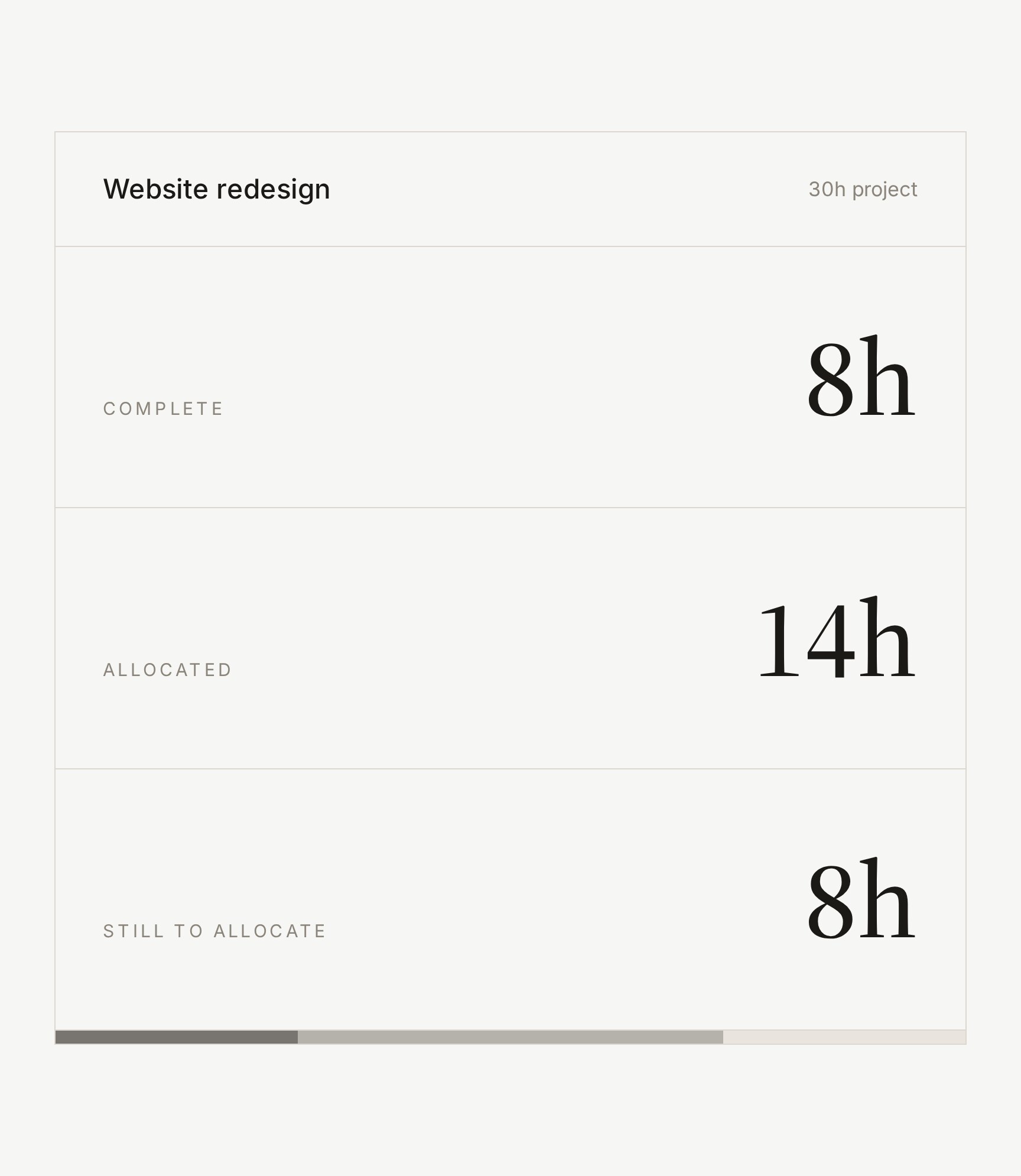
A project can look well organised while part of its work has no place in the plan. There is a brief, a deadline, some finished work and several sessions set aside. Everything visible looks reasonably settled. The difficulty is in the hours that are neither finished nor assigned to future time.
Those hours need a number of their own. Not a note saying “more to do”, or an assumption that the gaps will accommodate them. A visible remainder, held alongside the work already complete and the work already allocated.
This makes a useful distinction between knowing that work exists and knowing where it will fit. Both matter, but they are not the same planning task.
Three states, three different facts
Suppose you have committed 30 hours to a client project. Eight hours are complete. Another 14 are allocated to specific time in the coming weeks. That leaves eight hours still to allocate.
The whole commitment remains visible:
- Complete: 8 hours. Work already done.
- Allocated: 14 hours. Work assigned to available time, but not yet done.
- Still to allocate: 8 hours. Work you expect to do, with no time assigned yet.
Each state answers a different question. Complete tells you what has happened. Allocated tells you what has a place in the plan. Still to allocate tells you what remains unresolved.
The categories should not overlap. An hour cannot be both complete and allocated. Nor should an allocated hour be mistaken for progress simply because it appears in next week's plan. Reserving time is a decision about future work, not evidence that the work has happened.
For the current 30-hour commitment, the three figures add back to 30. Nothing sits outside the account merely because you have not decided when to do it. That is the discipline: keeping the whole commitment visible without pretending it is all settled.
Why the remainder matters most
Completed hours are reassuring because they describe something definite. Allocated hours can be reassuring too, because they show preparation. The remainder is less comfortable. It describes an obligation without an arrangement.
That discomfort is useful. It directs attention to the part of the project that still needs a decision.
Consider two projects, each with 20 hours left to do. One has 18 hours allocated and two still to allocate. The other has six hours allocated and 14 still to allocate. A report showing only “20 hours remaining” makes them look alike. As planning problems, they are quite different.
The first needs a small amount of additional space. The second still needs a substantial place in the working week. That does not automatically make the second project more urgent. Its deadline may be further away. But it does make the unresolved part of the commitment explicit.
The remainder is therefore more useful than a general sense of being busy. It gives you something specific to examine against the time available before delivery. Eight unallocated hours with six weeks to go mean something different from eight unallocated hours due on Friday.
It also distinguishes progress on the work from progress on the plan. Return to the 30-hour project. If you complete six of its allocated hours, the figures become 14 complete, eight allocated and eight still to allocate. You have made real progress. The unresolved planning requirement has not changed.
If you then assign four of the unallocated hours to available time, the figures become 14 complete, 12 allocated and four still to allocate. No additional work has been finished, but more of the commitment now has a place.
Both changes matter. Keeping them separate lets you see precisely what improved, rather than treating every movement as the same kind of progress.
A number to return to
A useful project review can begin with the remainder. Read the still-to-allocate figure alongside the delivery date, then look for suitable time. The next decision might be to assign a work session, agree a different delivery sequence or discuss what can reasonably be delivered. The figure does not make that decision for you. It tells you where one is needed.
There is no need to force every remainder to zero immediately. Work several months away may not need a detailed allocation today. Leaving some hours unallocated can be deliberate, provided the amount remains visible and you return to it as the delivery date approaches.
This is part of realistic planning: allocating project hours against the time you actually have. It is also the role of ourli. as a planning layer around the calendar, keeping the commitment in view while you decide where its hours belong.
A zero remainder means the current commitment has been fully allocated, not that delivery is guaranteed. A positive remainder means there is still a planning decision to make, not that the project is failing. The value lies in knowing the difference, and in having a clear number to return to.
Ahead, fortnightly.
Notes on time, work and planning before the deadline. One letter every two weeks.